
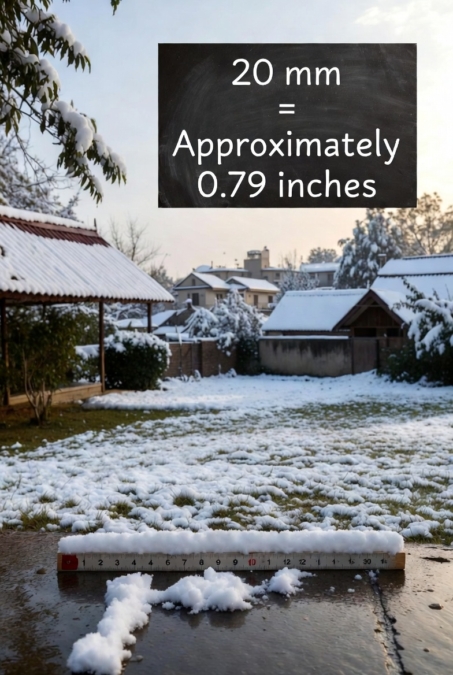
It is necessary to know how to convert measurements in order to interpret snow forecasts. And 20mm Snowfall Inch Conversion makes use of weather tools. The millimeters are widely used in reporting precipitation in many regions, whereas the inches are also used making it difficult to the user. This renders such conversion such as 20mm to inches particularly critical to clarity.
In time predictions of snowfall even slight variations in units can affect the ways in which individuals gear themselves up against winter weather. Measurement conversion can make users know the depth of the snow and the risk of traveling as well as possible disruption. This is the reason why the snow calculators tend to rely on the accurate unit conversion.
It is useful to know how to measure millimeters to inches whether you are checking a weather report or you are planning a trip during winter and you need to keep track of a storm. Forecasts are usually presented in terms of 20mm conversion and so the conversion is not a difficult one to be familiar with. Effective conversions produce effective decisions and increased winter preparedness.

The necessity of 20mm Snowfall Inch Conversion
The measurement of snowfall depends on the units used, as per the country or the service used to predict snowfall. Most weather agencies around the world report the precipitation in millimeters whereas the United States is using the inches. Such a combination of units can be confusing to the users who are dependent on snow calculators particularly when they would want rapid and precise conversions.
When the millimeters are converted to inches, users can gain access to easier interpretation of the snow forecasts, compare the weather reports on a regional basis, and make effective decisions regarding winter travel, school closures and home preparation. Because many snow calculators use both the metric and imperial system, understanding how to convert the two is more accurate and convenient.
Learning the Conversion: millimeters to inches
To change the millimeters (mm) to inches (in) you have to know the basic formula, which is as follows:
1 millimeter = 0.03937 inches
This conversion unit allows one to convert the measurements in a given metric to a commonly used imperial unit. By applying this formula, it is easy to convert any millimeter to inches, including the 20mm that is widely identified.
How to Convert 20mm to Inches
Let’s apply the formula:
- 20mm × 0.03937 = 0.7874 inches
- Thus, 20mm takes the value of about 0.79 inches when rounded to the nearest 2 decimal places.
The importance of this conversion lies in the fact that numerous snowfall calculators and weather applications cannot accept input in anything other than inches. The information about 20mm of snow is approximately less than an inch to enable users to have a better idea about the depth of the snow and possible dangers as well as prediction of the intensity.
The significance of 20mm of snowfall in Weather Reports
The amount of 20mm of snowfall is not a small matter. This is what it may imply in a normal winter weather:
1. Travel Disruptions
Snow depths of 20mm (0.79 inches) may result into slippery surfaces on roads, low visibility and hazardous driving conditions. Even minor amounts can lead to delays or minor mishaps.

2. School and Work Impact
Even though 20mm is not commonly substantial to induce mass closures, it can result in the reduction of the commute pace and changes in schedules. Depending on the temperature and ice-formation, schools can give delays.
3. More Snow Cleaning Requirement.
The homeowners might be required to clear the paths, driveways and sidewalks. Although not extreme, the amount is sufficient to warrant some consideration and particularly when coupled with freezing temperatures.
4. Early Warning in Forecasts
When the weather forecast indicates 20mm of the amount of snow that is expected to fall, it is usually the beginning of a bigger winter event. It becomes necessary to pay attention to the increasing numbers in order to be safe.
The application of Snow Calculators to get the Right Results
Snow calculators would assist the user to know how the accumulating snowfall could be due to many factors like:
- Temperature
- Precipitation rate
- Wind conditions
- Snow-to-liquid ratio
With values such as 20mm input, the calculator is more accurate in estimating the depth of snowfall. This is particularly true when it transforms the value into inches for use in the United States. This is to give the user an exact idea of the snow that they can anticipate.
Conclusion
The 20mm Snowfall Inch Conversion is a very easy calculation. It is still valuable to anyone who is in charge of monitoring snowfall or snow calculators. Having 20mm being equivalent to 0.79 inches, people will have a better idea on the conditions in winter, predict the severity, and what to prepare. Knowledge of this conversion is not only able to increase the weather awareness but also help to make safer decisions during the winter season.